
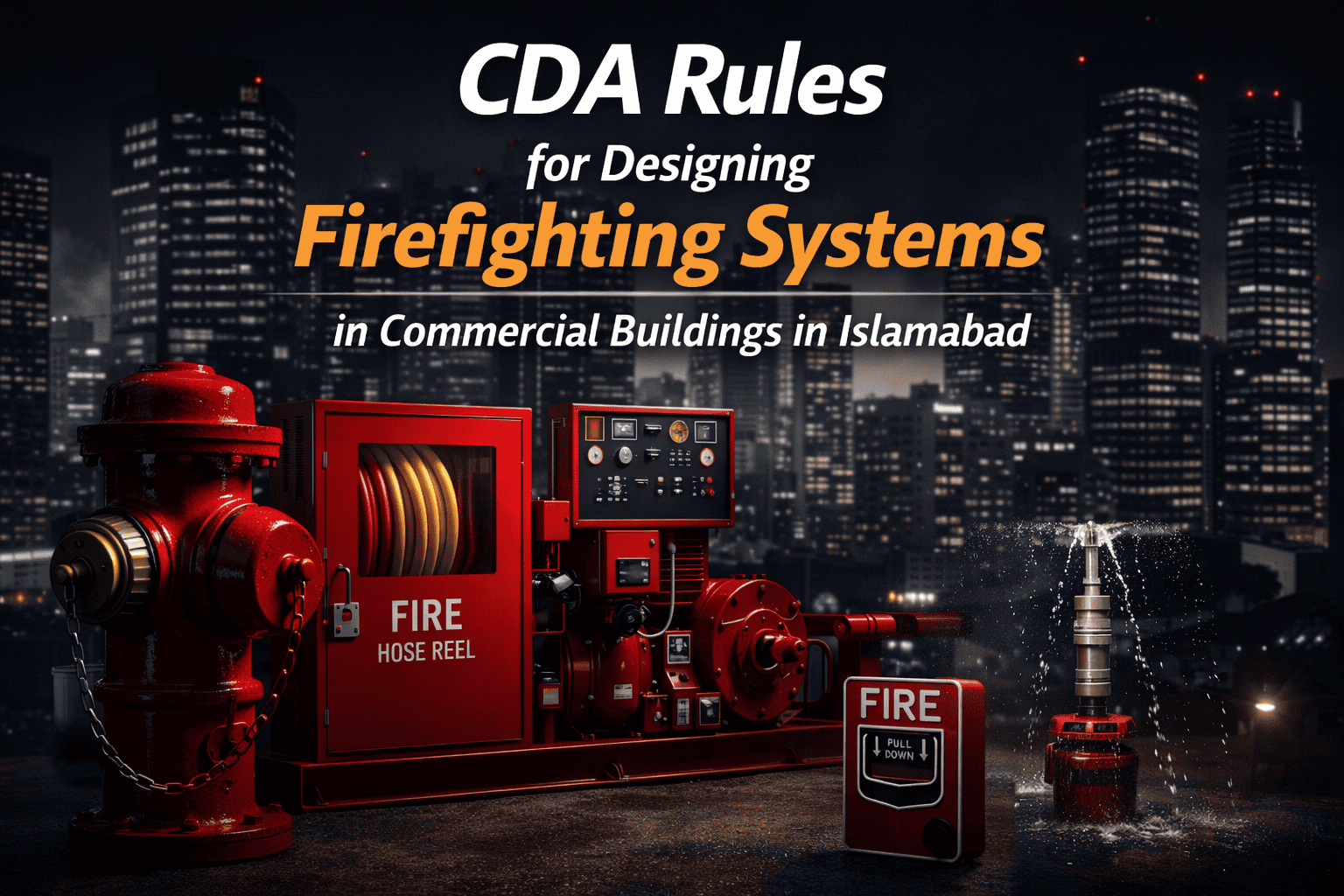
Fire safety in commercial buildings is not just a best practice — it is a legal requirement. In Islamabad, the Capital Development Authority (CDA) regulates building approvals and ensures that all commercial structures comply with fire safety standards.
If you are a developer, consultant, architect, or building owner, understanding CDA rules for designing firefighting systems in commercial buildings in Islamabad is essential to avoid approval delays, penalties, or operational risks.
This article explains the key CDA requirements, design considerations, and compliance guidelines for commercial projects.
Why CDA Firefighting Approval is Mandatory
Before construction or occupancy approval is granted, commercial buildings in Islamabad must submit:
- Firefighting system drawings
- Hydraulic calculations
- Equipment specifications
- Compliance documentation
CDA coordinates with relevant safety authorities to ensure that buildings meet required fire safety standards.
Failure to comply may result in:
- Rejection of building plans
- Delayed occupancy certificates
- Fines and penalties
- Legal liability in case of fire incidents
Key CDA Requirements for Commercial Buildings
While CDA often references international standards such as NFPA, it also imposes specific requirements based on building size, height, and occupancy.
Below are the main components required in commercial buildings.
1. Fire Hydrant & Standpipe System
CDA requires internal and external hydrant systems in most commercial buildings.
Requirements Include:
- Properly spaced landing valves
- Hose reel cabinets on each floor
- External yard hydrants
- Dedicated fire water storage tank
- Fire pump system (main + jockey pump)
For high-rise buildings, vertical standpipes must be installed to ensure water availability at upper levels.
2. Automatic Sprinkler System
Sprinkler systems are mandatory in:
- Shopping malls
- High-rise offices
- Hotels
- Mixed-use commercial complexes
- Basements and parking areas
The sprinkler system must be designed according to recognized standards such as NFPA 13.
Design submissions must include:
- Hazard classification
- Hydraulic calculations
- Sprinkler layout drawings
- Pump capacity calculations
3. Fire Alarm & Detection System
CDA requires commercial buildings to install a complete fire alarm system, which may include:
- Addressable fire alarm panel
- Smoke detectors
- Heat detectors
- Manual call points
- Sounders and strobes
For larger buildings, an addressable fire alarm system is typically required to allow precise detection and faster emergency response.
Integration with sprinklers, smoke control, and emergency lighting is often mandatory.
4. Fire Water Storage & Pump Room
Commercial buildings must provide:
- Dedicated underground or overhead fire water tank
- Separate fire pump room
- Diesel fire pump (for power failure backup)
- Jockey pump (pressure maintenance)
- Electric main fire pump
Pump rooms must be:
- Properly ventilated
- Easily accessible
- Clearly marked
5. Emergency Exits & Staircase Protection
CDA rules emphasize safe evacuation design.
Requirements include:
- Fire-rated staircases
- Pressurized stairwells (for high-rise buildings)
- Illuminated exit signage
- Emergency lighting systems
The goal is to ensure occupants can safely evacuate during smoke or fire conditions.
6. Smoke Management Systems
For large commercial projects such as malls or basements, CDA may require:
- Mechanical smoke extraction systems
- Jet fans in parking areas
- Staircase pressurization systems
- Fire dampers in HVAC ducts
These systems help maintain clear evacuation routes.
7. Basement Fire Protection
Basements in commercial buildings require special attention due to limited ventilation.
Mandatory systems often include:
- Automatic sprinklers
- Heat detectors
- Smoke extraction fans
- Fire-rated compartmentation
Parking areas must also include hose reels and hydrants.
Design Submission Process for CDA Approval
To obtain fire NOC (No Objection Certificate), consultants must submit:
- Firefighting layout drawings
- Pump room details
- Hydraulic calculations
- Equipment data sheets
- Compliance statement referencing standards
All drawings must be stamped by licensed professionals.
After installation, inspection may be conducted before final approval is issued.
Height-Based Requirements
CDA applies stricter rules for high-rise commercial buildings.
For example:
- Buildings above certain heights require sprinkler systems throughout
- Fire lifts may be required
- Refuge floors may be mandatory
- Pressurization systems become compulsory
High-rise structures must meet enhanced life safety standards.
Importance of NFPA Standards in CDA Projects
Although CDA has local authority, many firefighting system designs follow international standards such as:
- NFPA 13 (Sprinkler Systems)
- NFPA 14 (Standpipe Systems)
- NFPA 20 (Fire Pumps)
- NFPA 72 (Fire Alarm Systems)
Designing according to these standards improves approval chances and ensures system reliability.
Common Mistakes That Delay CDA Approval
- Incomplete hydraulic calculations
- Undersized fire water tanks
- Incorrect pump selection
- Missing smoke management system
- Poorly designed evacuation routes
- Non-compliant equipment
Engaging experienced fire protection engineers helps prevent these issues.
Why Professional Engineering is Essential
Firefighting systems are not just about installing equipment — they require:
- Risk assessment
- Hazard classification
- Water demand calculation
- System integration
- Code compliance
Poor design can result in:
- System failure during emergencies
- Approval rejection
- Increased insurance risks
Professional design ensures safety, compliance, and long-term operational reliability.
Conclusion
Understanding CDA rules for designing firefighting systems in commercial buildings in Islamabad is critical for developers and consultants.
From hydrant systems and sprinklers to fire alarms, pump rooms, and smoke management, each component must be carefully engineered and documented for approval.
Compliance not only ensures regulatory approval but also protects lives, property, and business continuity.
If you are planning a commercial project in Islamabad, consult experienced fire protection engineers to ensure your design meets CDA requirements and international safety standards.